Information About Late Blight
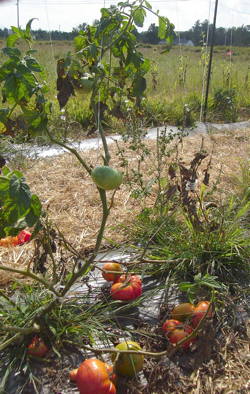 Phytophthora infestans affects both potato and tomato
plants. The strain in 2009 was the same as caused the infamous Irish
potato famine in the 1840s.
Phytophthora infestans affects both potato and tomato
plants. The strain in 2009 was the same as caused the infamous Irish
potato famine in the 1840s.
Early blight shows up as drying and dying leaves at the bottom of the plant. EB can be managed culturally, should not result in significant loss of crop. Mulching deters EB reducing rain splash on foliage.
Late blight usually starts at the top of the plant or on the windward side. As the earliest infection arrives on warm southerly winds, monitor the south and southeast sides of the garden carefully. Later in the season the wind can bring it from any direction. Early in the season, late blight infection shows as roundish lesions on leaves that uniquely will cross the center vein of the leaf. Later, blotches appear on stems. Still later, hard crusty lesions form on fruits.
Septoria Leaf Spot can appear almost overnight. It is characterized by yellowing and small circular spots on older leaves. It can eventually spread to the entire plant in conditions of high humidity and temperatures. It can be spread by wind or carried on clothing and tools. Septoria can live over the winter on live tissue, so don’t compost affected plants.
Preventing Late Blight
- Destroy, do not compost, any infected plants, fruits or parts. If you compost any diseased material, do not use that compost the next year.
- Late blight on tomatoes is not seed-borne. Saved tomato seed is okay if you ferment it properly.
- Grow your own tomato plants or buy locally grown seedlings. Know your farmer!
- Do not use saved potatoes as seed stock. Purchase only new certified-disease-free seed potatoes.
- Because disease spores travel air-borne, allowing unstaked plants to sprawl may reduce their vulnerability.
Amy LeBlanc’s Successful Battle
Here’s a distillation. For more information, contact Amy at Tomato Lovers Paradise, amy@whitehillfarm.com. We managed to miss the early round of blight as we grow all our own seedlings. However, it did arrive on the wind. Around July 18, I decided I was not going to lose my tomato crop. That meant buying two new hand-held sprayers and an NOP-approved copper fungicide formulation.
Available information was incomplete and conflicting. The most prevalent advice was “It’s terminal. Kill all your plants.” Instead I read all the references I could find about tomato diseases. The best information came from The Compendium of Tomato Diseases (Jones, Jones, Stall & Zitter, APS Press, ISBN 0-89054-120-5), from Cornell’s information site (see sidebar below) and from Dr. Bruce Watt at U. of Maine Plant Diagnostic Lab.
I monitored twice every day, and trained my workers to see the difference between early and late blights and to attack LB immediately and sytematically. We pruned extensively, clipping off every infected leaf and stem below every stem lesion, making sure the remaining pith was clear green. It’s important to take all infected material to the dump—not the compost pile. We followed each pruning with a copper spray (a total of five times at the recommended 5–10 day interval). The spray protected the fruit (which is damaged by surface spores rather than systemically). We harvested fruit as it began to ripen, washing with soap and water to remove the copper and spores, and it continued to ripen. We stayed at least one step ahead of the infection and we had a fabulous tomato crop.
Many of the protocols recommended by experts are farm-sized solutions. Small-scale gardeners can attend our plants daily. Consistent observation and action will see us through most problems.