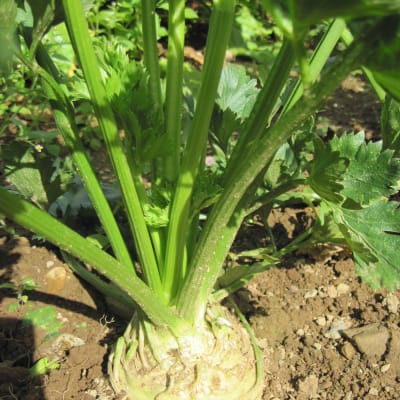
Apium graveolens var. rapaceum (95 days) F-1 hybrid. Slightly oblong 3–4" roots have nice mild flavor and dense white interiors that resist hollow heart and pithiness.
Apios graveolens var. rapaceum (100 days) Open pollinated. Gorgeous and delicious root vegetable tastes like celery but slightly nutty, with a texture like potato. Stores well, great for winter stews.
Apium graveolens var. rapaceum (100 days) Open pollinated. A classy early celeriac, high yielding with relatively smooth roots, uniform white internal color and splendiferous eating quality.
Loading...
Celeriac
The frog prince of root vegetables, celeriac is a staple in central and eastern Europe. Also called knob celery and celery root. Easier to grow than celery; an early start indoors is essential for good yields. Its nutty parsley-celery flavor is improved by light fall frosts. Can be stored up to 6 months in moist sand or damp leaves in the root cellar. Great raw for winter slaws and salads, it may be boiled, mashed or braised to enhance meat, fish and poultry.
Celery & Celeriac
About 1925-3000 seeds/g.
Days to maturity are from transplant date.
Culture: Must be started indoors in early spring, 10–12 weeks before transplant. Minimum germination temperature 40°, optimal range 70–75°, needs fluctuating temperatures. After germination, ambient air temperatures can be reduced but remain above 55° until transplanting. For one week prior to transplanting, go light on watering. Transplant outdoors when daytime temperatures are above 55° and the nights do not dip below 40°. Virginian Pam Dawling suggests that falling apple blossoms are a good phenological sign that transplanting time for these crops has arrived. Young seedlings grow slowly, requiring rich moist soil to survive. Regular rainfall or irrigation is necessary for good growth, flavor and yields. Celery withstands light fall frosts but is killed by serious cold.