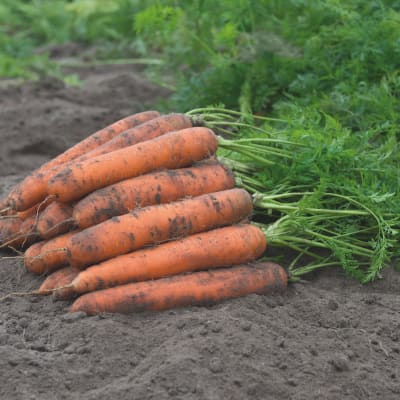
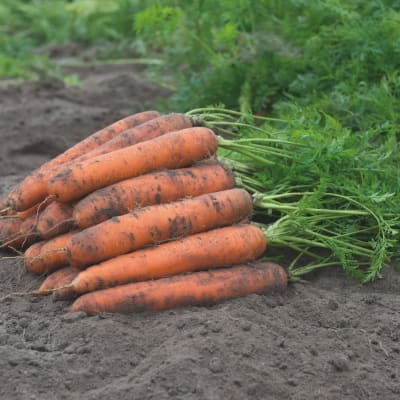
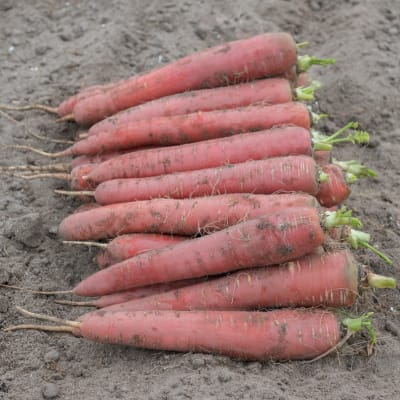
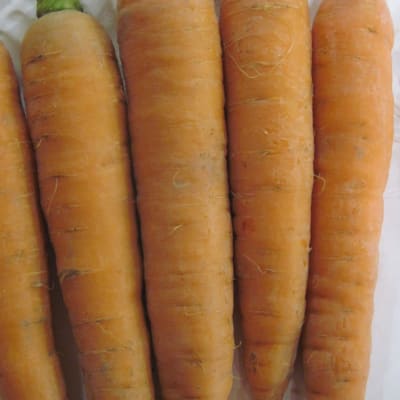
Daucus carota (55 days) Open pollinated. Early coreless translucent pinkish-orange blunt-tip roots. Mild sweetness boosted by “carrot perfume.” Upright tops good for bunching.
Daucus carota (55 days) Open pollinated. Early coreless translucent pinkish-orange blunt-tip roots. Mild sweetness boosted by “carrot perfume.” Upright tops good for bunching.
Daucus carota (55 days) Open pollinated. Parisian heirloom. Round 1½" deep orange carrot. Harvest young and tender; enjoy cooked for sweetness and creamy texture. Easy in clay soil.
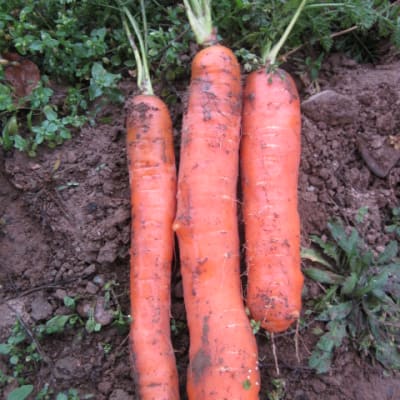
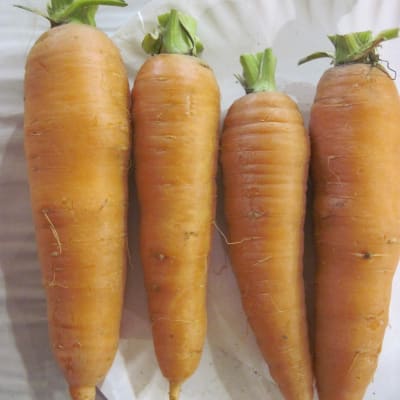
Daucus carota (68 days) Open pollinated. Uniform cylindrical 7" roots with unusually good interior color, crisp texture and fine flavor. Holds well; an excellent keeper too.
Daucus carota (55 days) F-1 hybrid. Blunt Nantes-type 7-8" orange carrot with strong green tops and a medium core. Snappy, sweet and juicy. Use fresh or store.
Daucus carota (70 days) Open pollinated. French heirloom. Thick 5-7" long red-orange carrot. Performs well in heavy soil. Excellent flavor and long storage.
Daucus carota (85 days) Open pollinated. A stalwart storage carrot whose flavor improves with time. Also good for fresh eating and juicing. 7–9" heavy cylindrical roots.
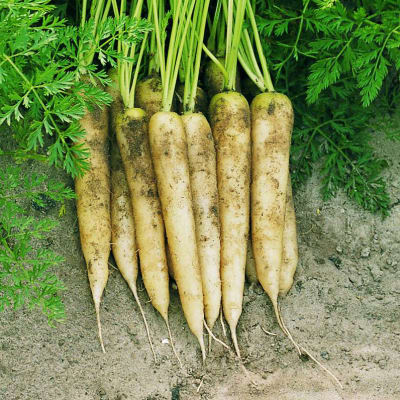
Daucus carota (70 days) F-1 hybrid. Straight 8" creamy-white carrot. Good texture and flavor, both raw and cooked. Develops green shoulders at full-size.
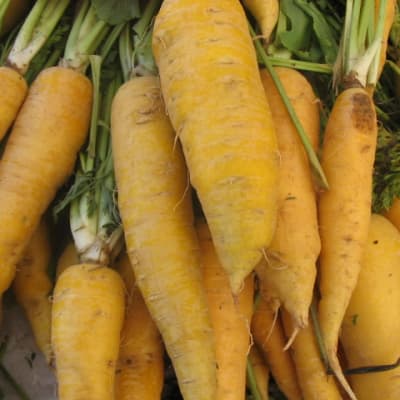
Daucus carota (72 days) Open pollinated. Large-shouldered 7-8" yellow carrot with greenish-yellow core. Performs well in diverse soil types.
Loading...
Carrots
500-1,000 seeds/g. Carrots average 18,000 seeds/oz with significant variations among varieties.
Days to maturity are from seeding date.
Culture: Very hardy. Early carrots can be sown by late April. For fall crop or winter storage, seed in early summer. Minimal germination temperature 40°, optimal range 75–85°. Can take up to 3 weeks to germinate; keep rows from drying out for faster emergence. Thinning is critical: At 3" high thin to ½" apart, at 6" thin again to 1-2" apart.
Diseases:
ALTS: Alternaria Leaf Spot
PM: Powdery Mildew
BR: Black Rot
TLS: Target Leaf Spot
LR: Licorice Rot
P: Pythium
ALTS shows up first on the oldest foliage as brown-black spots edged with yellow. Foliage blackens and shrivels as it develops and spreads. Maintaining a good crop rotation is the best preventive.