Pimpinella anisum (130 days) Open pollinated. White umbel flowers in July have delicate ornamental value. Seed ripens in August and September—wait until the tips of the fruits turn grey, and collect seeds before they turn black.
Agastache foeniculum Open pollinated. Perennial can grow 3' tall, 2' wide. Vigorous self-sower. Anise-scented foliage and purple flowers delightful as a tea or culinary seasoning, or filler in mixed bouquets.
Agastache foeniculum Open pollinated. Perennial can grow 3' tall, 2' wide. Vigorous self-sower. Anise-scented foliage and purple flowers are delightful as a tea or culinary seasoning, or filler in mixed bouquets.
Withania somnifera Open pollinated. Upright shrub 2' with green-to-yellow flowers ripening to red berries. Roots are dried at the end of the growing season and used internally powdered or tinctured.
Codonopsis pilosula Open pollinated. Perennial to Zone 4. Used in Chinese medicine like ginseng, but considerably easier to grow than true Panax ginseng.
Dysphania ambrosioides (55 days) Open pollinated. Culinary herb native to Central America, often added to beans to deepen flavor and to mitigate flatulence. Sharp and pungent.
Trigonella foenum-graecum (30 days leaf, 120 days seed) Open pollinated. Leaf and seeds are used culinarily, imparting a sweet nutty flavor reminiscent of maple syrup.
Hyssopus officinalis Open pollinated. Perennial. Normally hardy to Zone 3. Beautiful aromatic perennial border plant that produces spikes of indigo flowers.
Alchemilla mollis Open pollinated. Perennial. 12-18" Bears large loose sprays of tiny greenish-yellow flowers from early summer onward. Makes a good border and ground cover in shady locations.
Levisticum officinale Open pollinated. Perennial. Umbelliferous, attracts beneficial insects, grows 3-6' and makes a dramatic architectural element in a decorative border.
Silybum marianum Open pollinated. Named for the bold white splashes on its glossy leaves, said to be from Mary’s milk. Fast-growing 3-5' annual with leaves up to 8x24".
Leonurus cardiaca Open pollinated. Perennial 2–4' plant with dull green leaves and tiny white to purple blooms. Bees love the flowering tops, which are used for tea or herbal tincture.
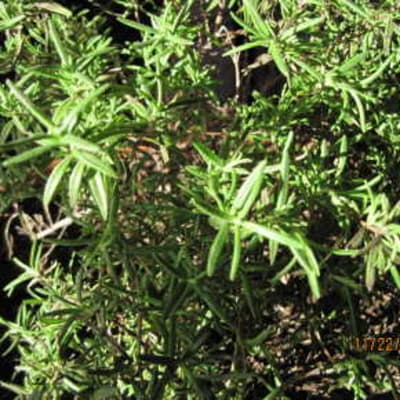
Rosmarinus officinalis Open pollinated. Beloved tender perennial growing to 3-4'. Cannot withstand temperatures below 17°, may be overwintered indoors if kept cool and moist.
Spilanthes oleracea Open pollinated. Used as a ground cover in the south, it adds unusual beauty with its low growth habit and its cute yellow flowers with rayless red-orange centers.
Spilanthes oleracea Open pollinated. Used as a ground cover in the south, it adds unusual beauty with its low growth habit and its cute yellow flowers with rayless red-orange centers.
Stevia rebaudiana (100-120 days) Open pollinated. Stevia is several hundred times sweeter than sugar, and is used fresh, dried, powdered or in a liquid as a sugar substitute.
Origanum majorana (80-95 days) Open pollinated. Grown as an annual in the North. 1' plant with grey-green rounded leaves of enchanting sweet fragrance.
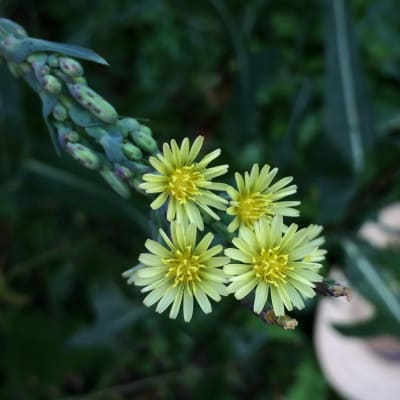
Lactuca serriola (60 days) Open pollinated. Readily grows as a spring-sown annual.Young leaves are edible, and the plant can be milked for its medicinal latex.
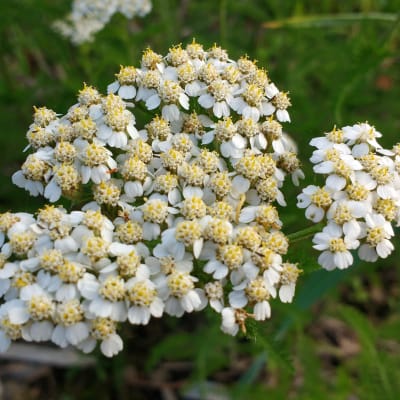
Achillea millefolium Open pollinated. Perennial grows 1-2', spreads slowly, preferring lean soil. Rich garden soil may produce lush 3' plants that need staking. Zone 2.
Sinapis alba (70-85 days) Open pollinated. As easy to grow as the leafy mustards. The variety of mustard most familiar to American palates, but pallid without the addition of turmeric.
Matricaria recutita Open pollinated. One of the most widely known herbs, powerful yet gentle, long used to promote relaxation. Perhaps a tad less sweet than others.